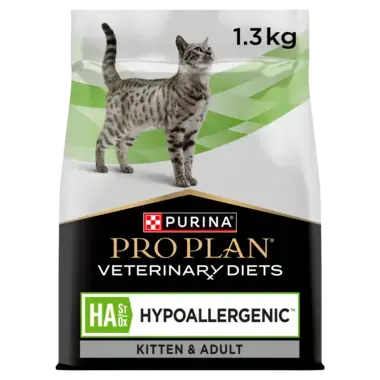
PRO PLAN® VETERINARY DIETS HA Hypoallergenic Dry Cat Food
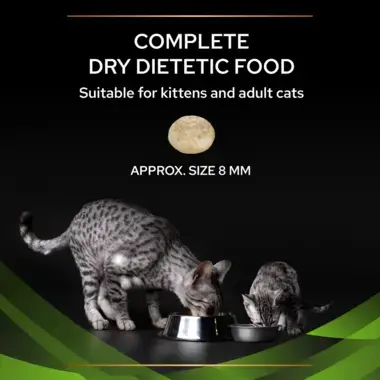
PRO PLAN® HA Hypoallergenic Dry Cat Food complete dietetic food for kittens and adult cats, formulated with a single hydrolysed protein and selected carbohydrate sources to help reduce food intolerances and minimise allergic reactions.
Key benefits
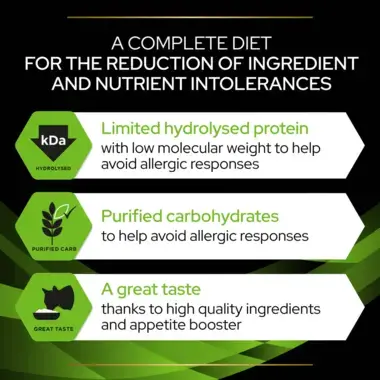
Helps reduce ingredient and nutrient intolerances while supporting skin and digestive health.
- Limited hydrolysed protein with low molecular weight to help avoid allergic reactions.
- Purified carbohydrates to help avoid allergic reactions.
- A great taste thanks to high quality ingredients and appetite booster.
- Helps maximise natural anti-inflammatory processes to minimise allergic responses.
Support your cat’s dietary needs with tailored hypoallergenic nutrition from PRO PLAN®.
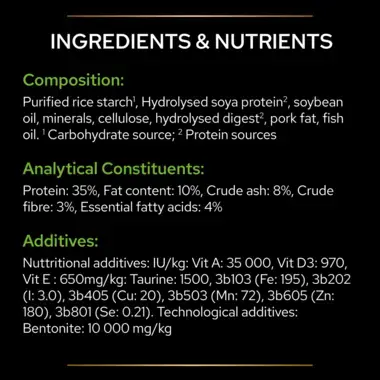
Complete dietetic pet food for kittens and adult cats for the reduction of ingredient and nutrient intolerances, formulated with hydrolysed protein sources, selected carbohydrate sources and appropriate combination of the essential nutritional characteristics.
- Protein 35.0 %
- Fat content 10.0 %
- Crude ash 8.0 %
- Crude fibre 3.0 %
- Essential fatty acids 4.0 %
- Vit A: 35,000
- Vit D3: 970
- Vit E: 650
- Taurine: 1500
- Iron (II) sulphate monohydrate: (Fe: 195)
- Calcium iodate anhydrous: (I: 3.0)
- Copper (II) sulphate pentahydrate: (Cu: 20)
- Manganous sulphate monohydrate: (Mn: 72)
- Zinc sulphate monohydrate: (Zn: 180)
- Sodium selenite: (Se: 0.21)
- Bentonite: 10 000
- 364kcal per 100g
Did you know that we can offer you a more accurate feeding recommendation based on your dog's size and weight? Scroll down, click start and get personalised advice on how much to feed.
Feeding guide
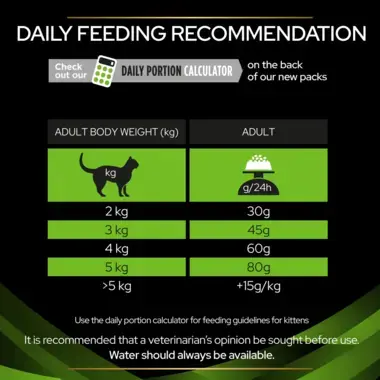
The recommended period of use is 3 to 8 weeks. If signs of intolerance disappear, this feed can be used initially up to one year. It is recommended that a veterinarian’s opinion be sought before use or before extending the period of use. For kitten feeding guidelines, check the daily portion calculator. Water should always be available.
ADULT
| Body weight (kg) | Daily feeding quantity (g/day) |
|---|---|
| 2 | 30 |
| 3 | 45 |
| 4 | 60 |
| 5 | 80 |
| >5 | +15 g/kg |
KITTEN GROWTH
| Age (weeks) | Daily feeding quantity (g/day) |
|---|---|
| 6 - 12 | 25 - 80 |
| 12 - 26 | 50 - 110 |
| 26 - 52 | 110 - 55 |
The PRO PLAN Veterinary Diets range has been created to help veterinary surgeons provide nutritional support for specific health conditions in dogs and cats. The range of clinical diets and related products enables vets to strengthen the effectiveness of overall treatment protocol with targeted, science-based and proven formulas.
Learn more about us
Common questions about Pro Plan Veterinary Diets
This is a tricky one to answer right now. We need a little more information to help you decide.
With so many different factors to take into consideration when selecting the right diet, it's no wonder pet owners become overwhelmed with the choice.
However, don't worry! With a few more questions answered, our PetCare Team will be able to guide you in the right direction. Give us a call on 0800 212 161, or message us through the Contact Us page and we can start the conversation.
Changes in diet can be stressful for your cat and can lead to digestive upsets and food refusals.
Cats can have very strong individual preferences for diet and transition to a new one can sometimes be quite challenging. A number of considerations might help support a successful diet transition.
Consider any dietary preferences:
• Is a wet or a dry food preferred, or a combination of both?
• If your cat prefers wet food, do they prefer chunks in a gravy or jelly, or a mousse?
• Do they have any flavour preferences?
Introduce the diet in a non-stressful environment:
• Try to find a quiet area at home, away from other pets, loud noises, or any litter trays.
• Ensure your cat has their own food bowl (cats don’t usually like to share!)
• If your cat has come home from the veterinary practice with a new diet, depending on the condition the diet is being recommended for, it may be better to give time for him/her to fully settle before introducing.
• Consider using feline pheromones, which may help reduce stress and make cats feel more secure.
• Don’t stand over your cat – most cats prefer time and space to accept their new food.
Consider diet introduction in a new bowl (next to a bowl with the old food):
• The amount of old food should gradually be reduced and amount of new food increased over 7-10 days.
• Most cats prefer two separate food bowls, rather than mixing of the food.
• Sometimes, the transition can take much longer than 7-10 days so don’t become disheartened. Some cats may take a month or longer to accept a new food
Ensure your cat does not seem nauseous (for example, going to the food bowl then turning away). If you are concerned about nausea, speak to your vet.
Avoid food aversions by administering any medications in a different, highly palatable food, at a separate time to the cat’s main meal.
Serving considerations:
• Serve food at room temperature or above.
• If only part of a pouch or can is given at a meal, ensure it is stored in the fridge and disposed of after 24 hours if not used. Bring it up to room temperature before serving: cats generally don’t like chilled foods.
• If feeding wet food, gentle heating to increase the aroma may help.
Ensure food is always fresh, particularly wet food:
• Dispose of wet food not eaten after 30 minutes and try again later in the day.
Consider location and height of food bowls:
• Locate food bowls away from water bowls or litter trays.
• If your cat suffers from conditions such as osteoarthritis, slight elevation of the food bowl off the floor might increase comfort when eating.
Palatability enhancers may also be helpful e.g. PRO PLAN® Fortiflora (a probiotic supplement, which many cats also find highly palatable).
If your other pet doesn’t need a special diet, we recommend that you double check with your vet before feeding.
Some diets are perfectly safe to feed, while others, such as a renal or urinary diet may cause problems in pets that don’t necessarily need it.
If you still need some guidance, feel free to give the PetCare Team a call on 0800 212 161 (9am-5pm, Monday to Friday excluding bank holidays) and we can start the conversation.
Cats and dogs’ nutritional needs are very different from those of humans and a certain proportion must be obtained from specific ingredients. For example, cats have a unique and necessary requirement for animal protein so can never become vegetarian. In addition, both dogs and cats need varying levels of different nutrients depending on their age and daily activity levels, as well as many other lifestyle factors. Satisfying these varying demands with homemade pet food is very difficult because you need an in-depth knowledge of your pet’s individual physiology and nutritional needs. This means that there is a real risk the homemade dog or cat food you prepare could leave your pet without essential nutrients and have a negative impact on their health in both the medium and long term leading to conditions such as bone density problems and/or malformations.
With more than 90 years of experience in research and nutrition in the field of pet food and over 500 nutritionists, veterinarians, behaviourists and food scientists, we make food that consistently ensures the correct balance of right nutrients and energy requirements for your pet formulated to satisfy their unique nutritional needs.
We also make special veterinary diets that are available on the recommendation of a vet to help nutritionally support specific clinical conditions. For example: if your dog or cat has an allergic reaction to certain ingredients, we offer a specially manufactured hydrolyzed diet that is specially formulated to reduce reactions to the food. Alternatively, if your cat is diagnosed with Diabetes Mellitus we offer a veterinary product that has been scientifically proven to reduce the level and frequency of insulin injections required.
Using high quality processed pet food also offers other advantages, such as decreased health risks. Thanks to stringent manufacturing processes and multiple safety checks from raw ingredient sourcing through to warehouse storage the final manufactured pet food is safe for your pet to eat.